



Qu'est-ce que l'arthrose ?
L'arthrose ou l'usure du cartilage de l'articulation
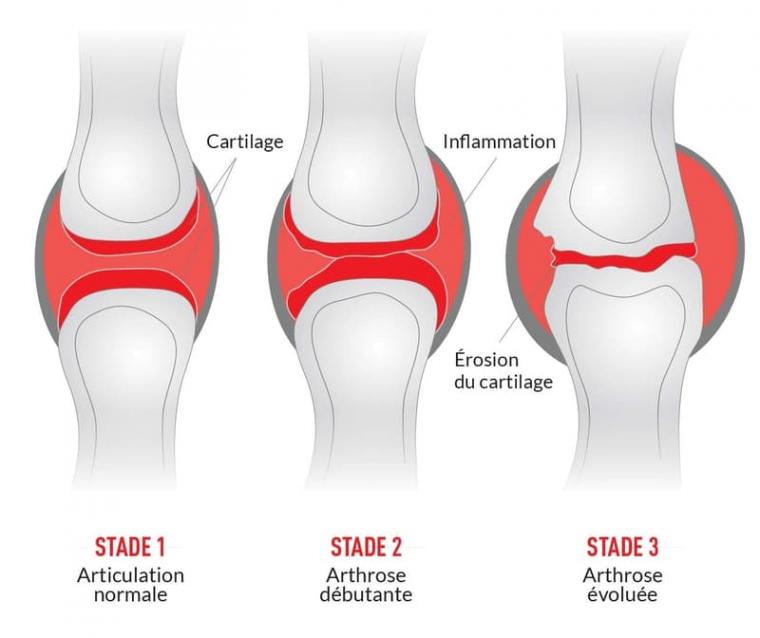
L'arthrose correspond à l'usure du cartilage de l'articulation accompagnée d'un déséquilibre entre la synthèse (ou anabolisme) et la dégradation (ou catabolisme) des cellules du cartilage (ou chondrocytes) et de l’os sous-chondral. Elle se caractérise macroscopiquement et histologiquement par des altérations du cartilage articulaire sous forme d’érosions et de fissures qui peuvent mettre à nu l’os sous-chondral (1).
L’arthrose est la résultante de phénomènes mécaniques et biologiques.
Ce déséquilibre peut être initié par de multiples facteurs : la génétique, l’âge, le métabolisme (lié à l’obésité) et les traumatismes (arthrose post-traumatique).
L'arthrose affecte toutes les structures
L’arthrose, en affectant toutes les structures, aboutit à la dénaturation progressive du cartilage articulaire, à la sclérose de l’os sous-chondral avec constitution d’ostéophytes et de kystes qui conduisent à la perte progressive de la congruence articulaire, source de douleur, de raideur, de déformation et d’épanchement, avec des degrés variés d’inflammation locale (2).
L'arthrose : un phénomène complexe
L'arthrose est un phénomène complexe faisant intervenir des facteurs physiques et métaboliques.
Dans une articulation, le cartilage recouvre l'extrémité des os et participe à la mobilité articulaire avec un minimum de frottements. Les cellules sont remplacées au même rythme qu'elles sont détruites. L'articulation conserve ainsi toutes ses capacités de mobilité. Lorsque le remplacement des cellules est plus lent que leur disparition, et/ou que les contraintes physiques (chocs, frottements répétés) sont trop importantes, l'équilibre métabolique de l'articulation se dérègle.
L'usure du cartilage
L'usure du cartilage débute alors par des fissures qui se creusent peu à peu jusqu'à la formation de véritables trous (ulcérations). L'os peut se retrouver par endroit complètement à nu et les surfaces osseuses rentrent en contact direct (1).
Quatre principaux phénotypes d’arthrose ont été identifiés :
- le premier est l’arthrose dite métabolique ou liée à l’obésité, dont la prévalence n’a cessé d’augmenter ces dernières décennies pour des raisons évidentes environnementales et sociétales,
- le second est l’arthrose liée à l’âge, également en augmentation eu égard au vieillissement de la population,
- le troisième est l’arthrose post-traumatique,
- le quatrième est l’arthrose génétique (3).
Quelles sont les conséquences de l'arthrose ?
Arthrose et mobilité articulaire
L’arthrose aboutit à la limitation douloureuse de la mobilité articulaire : l'articulation est de plus en plus raide (1). La douleur arthrosique se réveille à l'utilisation de l'articulation et se calme avec le repos. Certaines formes inflammatoires sont toutefois également douloureuses la nuit (4).
Les articulations du corps les plus touchées
L'arthrose peut toucher toutes les articulations du corps, mais plus souvent (1, 4) :
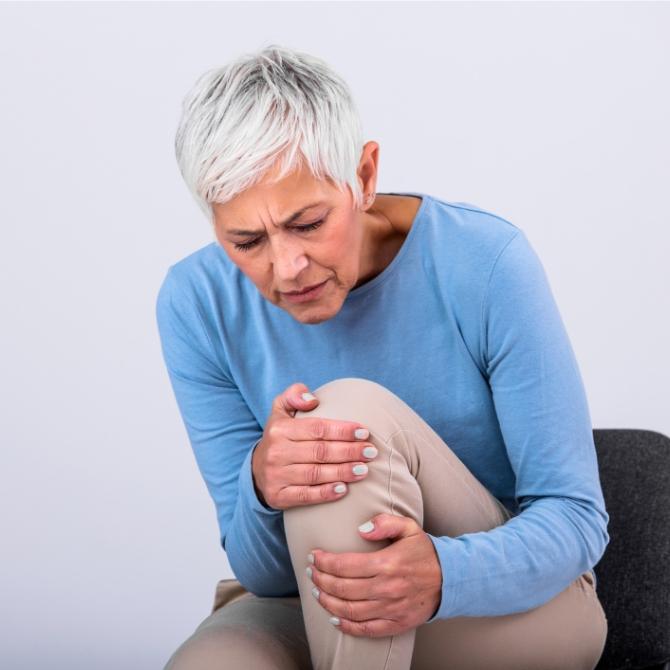
- les genoux,
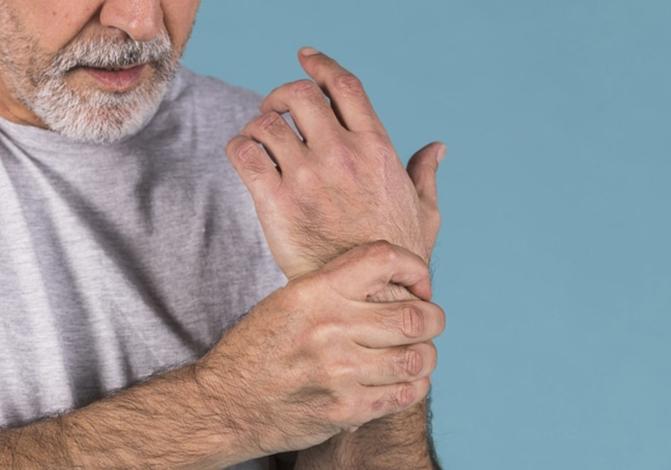
- les mains,
- la colonne vertébrale
- les hanches
Il n'est pas rare qu'une personne arthrosique soit touchée par plusieurs segments.
Evolution de l'arthrose
- Gonarthrose (arthrose du genou) : évolue lentement et peut même se stabiliser.
- Rhizarthrose (arthrose du pouce) : évolue généralement par poussée plus ou moins inflammatoire.
- Cervicarthrose (arthrose des cervicales) : évolue progressivement sur plusieurs années.
Face à l'arthrose, disons les choses !
Zoom sur la France
- 2ème cause d'invalidité en France (12, 13)
- 12,3% de la population française serait atteinte d’arthrose soit 9 à 10 millions de personnes atteintes en France (14)
- L’âge moyen en France de l’arthrose est de 64,2 ans et les femmes sont plus touchées que les hommes (5)
Nombre de consultations liées à l'arthrose
En ville, en 2002, 13,4 millions de consultations pour arthrose ont été répertoriées dont environ 12 millions chez les généralistes et 1 million chez les rhumatologues (6, 7).
Actuellement, en considérant la population arthrosique symptomatique en France, un patient consulte en moyenne 3 fois par an pour sa pathologie et obtient une prescription à l’issue de sa consultation dans 94 % des cas.
Sur les 10 dernières années
La population arthrosique symptomatique a progressé de 54 %, passant de 3 millions de personnes symptomatiques à 4,6 millions de personnes actuellement (6).
Arthrose et activités physiques
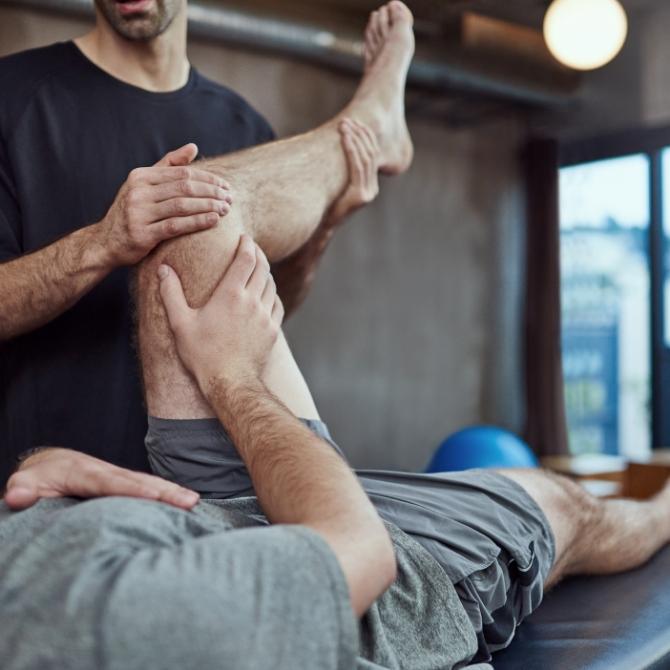
Des exercices adaptés, la kinésithérapie et une activité physique associés à des moyens thérapeutiques permettent de mobiliser l'articulation. (8)
L'arthrose n'empêche pas la pratique d'une activité sportive qui est même recommandée comme traitement non médicamenteux sous la forme d'activité physique adaptée (APA). L'accent a été mis sur la personnalisation du programme d'exercices et l'importance de l'éducation thérapeutique. Cette activité physique adaptée se traduit sous la forme d'exercices de renforcement, d'étirement, de proprioception et de travail en aérobie. (8)
Pour stabiliser une articulation, et limiter le développement ou l'aggravation d'une arthrose, il est nécessaire de maintenir l'équilibre de la force musculaire. Un programme associant exercice de renforcement musculaire et endurance chez un patient arthrosique pourrait améliorer ses capacités fonctionnelles et diminuer les douleurs. (8)
Quelles solutions adopter quand on a de l'arthrose ?
L'American College of Rheumatology (ACR) recommande comme traitement de 1ère intention dans l'arthrose des mains et des membres inférieurs :
- l'Activité Physique Adaptée (APA)
- le contrôle du poids,
- la prescription d'orthèses
- les traitements médicamenteux (Daste Rev Rhum Monog 2021) (8)
Quel que soit la localisation et les comorbidités associées, de nombreux exercices spécifiques ou non spécifiques, à sec ou en milieu aquatique, dans des programmes structurés visant à améliorer la mobilité articulaire, la force, la proprioception et les capacités aérobies sont conseillés lors de l'APA. (8)
Des recommandations sont valables pour la main, le genou et les hanches (8) :
- Exercices
- Acupuncture (de manière conditionnelle)
- Intervention thermique (de manière conditionnelle)
D'autres solutions sont recommandées par l'American College of Rheumatology par partie du corps :
Il existe des solutions spécifiques à une ou plusieurs parties du corps touchées par l'arthrose : l'entrainement à l'équilibre, la perte de poids, le tai chi, une canne sont recommandés pour l'arthrose située aux genoux ou aux hanches. (8)
Les orthèses de mains et la paraffine sont recommandées pour l'arthrose de la main. (8)
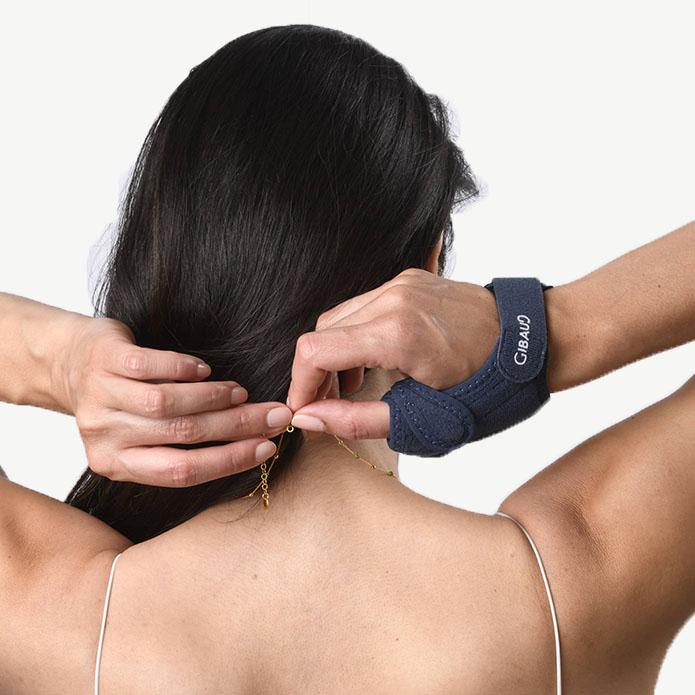
L'American College of Rheumatology recommande le port d'orthèses dans le cadre de la prise en charge de l'arthrose, car elles permettent le maintien de l'articulation sur une position fixe. (8)
Adoptez le réflexe Gibaud® !
Vous souffrez d'arthrose ? Choisissez les orthèses Gibaud®.
Rhizarthrose
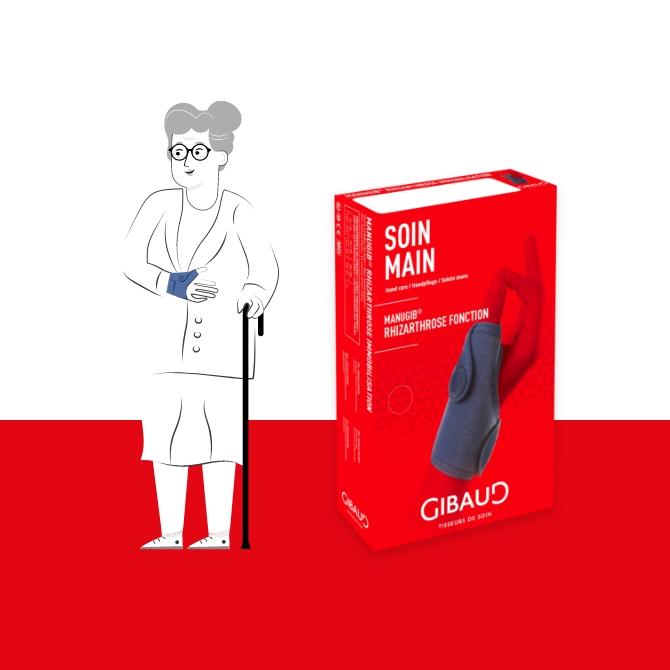
La rhizarthrose, est la forme la plus fréquente d'arthrose de la main (9). Il s'agit d'une pathologie touchant principalement les femmes : 38% des femmes de plus de 75 ans seraient touchées (10).
Pour la rhizarthrose, Gibaud® propose des solutions qui facilitent la vie et les gestes du quotidien. Les orthèses Manugib® de Gibaud® offrent une gamme complète pour soulager la douleur.

Arthrose du rachis cervical
L'articulation du cou, le rachis cervical, peut être touchée par l'arthrose. On appelle ce type d'arthrose : la cervicarthrose. Elle fait partie des articulations les plus souvent touchées par l'arthrose. (11)
Le conseil Gibaud® : porter un collier cervical pour restreindre le mouvement.
Arthrose du genou
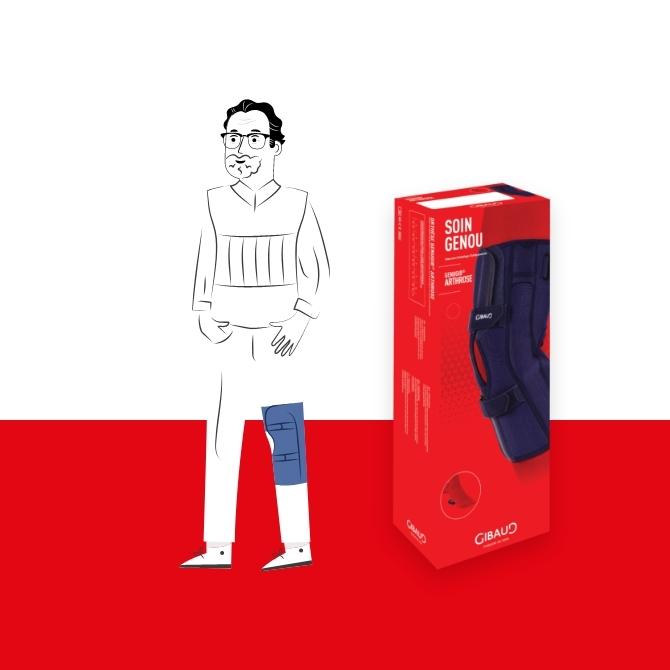
En France, plus de 1,3 millions de personnes souffriraient de cette pathologie, plus communément appelé gonarthrose. (4)
Découvrez notre nouvelle orthèse Genugib® Arthrose Gibaud®. Elle stabilise le genou et absorbe les chocs grâce à sa talonnette amortissantes Noene®.

GIBAUD®, expert sur les produits dédiés à l'arthrose.
Nous plaçons les personnes au coeur de notre attention et prenons soin d'elle.
Références :
- Richette (2005). Arthrose. La Revue du praticien (Paris), 55 (17), 1933-1942.
- Tebib (2006). Physiopathologie de l’arthrose. In: La gonarthrose. Springer, Paris. 13-23
- Eymard (2020). Scénario général de l’arthrose. Revue du Rhumatisme Monographies. 88, 79-84.
- Lagorce et al. (2016). Comprendre l’arthrose. Actualités Pharmaceutiques, 55(555), 18-22.
- Palazzo et al. (2014). The Burden of Musculoskeletal Conditions. PLoS ONE 9(3): e90633.
- Le Pen et al. (2005). Financial cost of osteoarthritis in France: the “COART” France study. Joint Bone Spine, 72(6), 567-570.
- Reygrobellet & Le Pen (2004). Coart France rapport 2003 sur les nouvelles données socio-économiques de l’arthrose en France. La Presse Médicale, 33(9), 4-6.
- Kolasinski et al . (2020). Directive 2019 de l'American College of Rheumatology/Arthritis Foundation pour la prise en charge de l'arthrose de la main, de la hanche et du genou. Arthrite et rhumatologie, 72(2), 220-233.
- Berruth, (2014). Arthrose de la base du pouce (rhizarthrose) du sujet âgé. Gériatrie et Psychologie Neuropsychiatrie du Vieillissement, 12(4), 361-370.
- Haara et al. (2004). Arthrose de l'articulation carpométacarpienne du pouce : prévalence et associations avec l'invalidité et la mortalité. JBJS, 86(7), 1452-1457.
- Richette (2008) Généralités sur l'arthrose : épidémiologie et facteurs de risque. EMC (Elsevier Masson SAS, Paris), Appareil locomoteur, 14-003-C-20, 2008.
- Fautrel et al. (2005). Retentissement fonctionnel de l'arthrose : résultats d'une enquête nationale effectuée auprès de 10 000 patients consultatn pour arthrose. Revue du rhumatisme, 72(5), 404-410.
- Breville, et al .. (2015). Le fardeau de l'arthrose. Les cahiers de l'année gérontologique, 7(2), 45-51.
- Direction Générale de la Santé en collaboration avec l'INSERM, Rapport du GTNDO, Analyse des connaissances disponibles sur les problèmes de santé sélectionnés, leurs déterminants, et les stratégies de santé publique Définition d'objectifs. Président : Abenhaim L., Rapporteur : Le Gales C. Mise à jour Mars 2003.